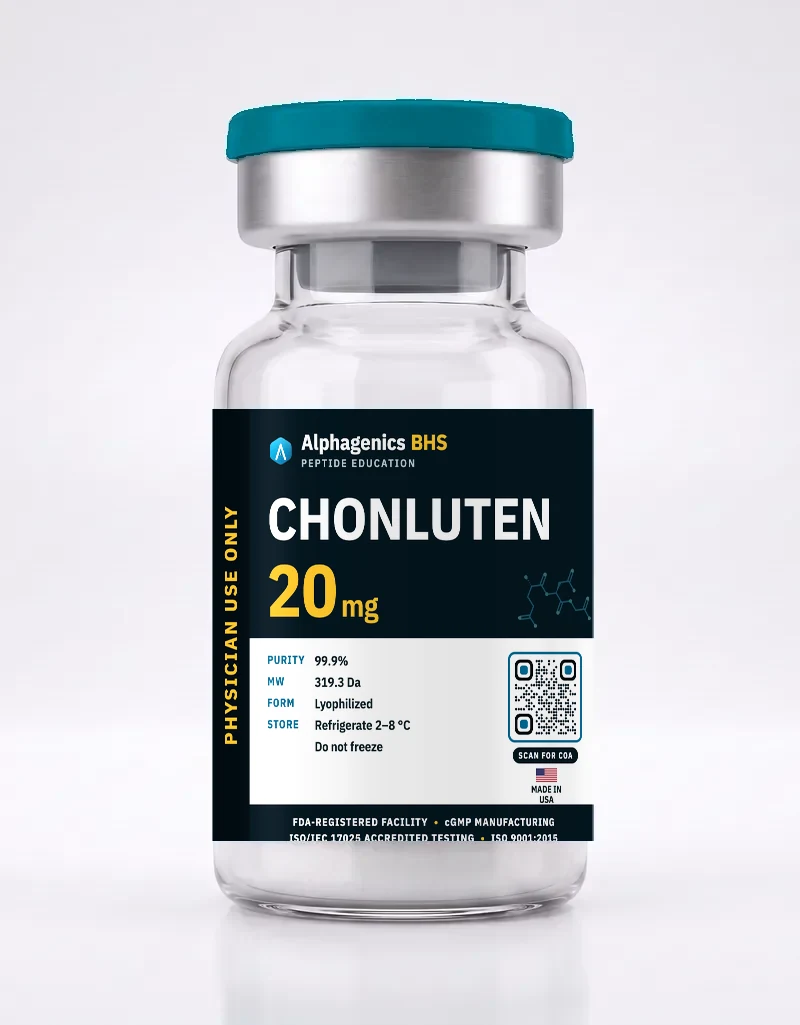
Chonluten
Glu-Asp-Gly · EDG · T-34
Synthetic tripeptide (short peptide bioregulator)
About Chonluten
Chonluten (Glu-Asp-Gly, EDG) is a synthetic tripeptide from Professor Vladimir Khavinson's group at the Saint Petersburg Institute of Bioregulation and Gerontology, described by its authors as related to the bronchial epithelium.
The literature on this molecule indexed in PubMed is very limited: it consists of cell and tissue culture studies, one paper on antioxidant and anti-inflammatory genes, and a computer modeling study. The evidence comes largely from a single research group, is preclinical, and no human studies were found.
Structure and sequence
Sequence

Five findings from studies
Summary of results reported in the scientific literature. Each finding describes what was observed in the cited study, in its specific population and conditions; it does not constitute a therapeutic indication.
-
In vitro
In the human THP-1 monocyte cell line, chonluten has shown inhibition of TNF production by monocytes exposed to bacterial lipopolysaccharide (LPS); in the same study, all five peptides tested increased tyrosine phosphorylation of mitogen-activated cytoplasmic kinases.
Avolio F et al. Int J Mol Sci. 2022;23:3607 · PMID 35408963 -
In vitro
In the same study, in differentiated THP-1 cells, all peptides tested, including chonluten, have been associated with lower LPS-induced TNF and IL-6 expression and with reduced cell adhesion to LPS-activated endothelium.
Avolio F et al. Int J Mol Sci. 2022;23:3607 · PMID 35408963 -
In vitro
In organotypic skin cultures from young rats, tripeptide T-34 (Glu-Asp-Gly) was the only one of the five tripeptides studied that did not stimulate cell proliferation; in skin from old rats, the marked stimulatory effect was seen with a different tripeptide (Lys-Glu-Asp).
Voicekhovskaya MA et al. Bull Exp Biol Med. 2012;152:357-359 · PMID 22803085 -
Preclinical
In a paper by the same group related to gastric ulcer, peptide T-34 has been described as regulating the expression of genes for antioxidant and anti-inflammatory proteins and normalizing their synthesis; the abstract does not detail the experimental model.
Khavinson VKh et al. Bull Exp Biol Med. 2012;152:615-618 · PMID 22803148 -
In silico
In a computer-based molecular modeling and docking study, EDG was among the short peptides with the highest predicted affinity for the LAT1, LAT2 and PEPT1 transporters; the authors hypothesize that a possible antitumor effect of this and other peptides could be related to inhibition of these transporters.
Khavinson VK et al. Biomolecules. 2023;13:552 · PMID 36979488
Frequently asked questions
What is Chonluten?
Chonluten (Glu-Asp-Gly, EDG) is a synthetic tripeptide from Professor Vladimir Khavinson's group at the Saint Petersburg Institute of Bioregulation and Gerontology, described by its authors as related to the bronchial epithelium. The literature on this molecule indexed in PubMed is very limited: it consists of cell and tissue culture studies, one paper on antioxidant and anti-inflammatory genes, and a computer modeling study.
What target or receptor does Chonluten act on?
Not established; regulation of gene expression has been proposed (proposed)
What is the half-life of Chonluten?
Not established in humans
What have published studies observed about Chonluten?
In the human THP-1 monocyte cell line, chonluten has shown inhibition of TNF production by monocytes exposed to bacterial lipopolysaccharide (LPS); in the same study, all five peptides tested increased tyrosine phosphorylation of mitogen-activated cytoplasmic kinases. (Avolio F et al. Int J Mol Sci. 2022;23:3607, PMID 35408963) In the same study, in differentiated THP-1 cells, all peptides tested, including chonluten, have been associated with lower LPS-induced TNF and IL-6 expression and with reduced cell adhesion to LPS-activated endothelium. (Avolio F et al. Int J Mol Sci. 2022;23:3607, PMID 35408963)
How is Chonluten stored?
Refrigerate at 2–8 °C, do not freeze. Protect from light and moisture, unopened and once reconstituted.
What sizes is Chonluten available in?
20mg


