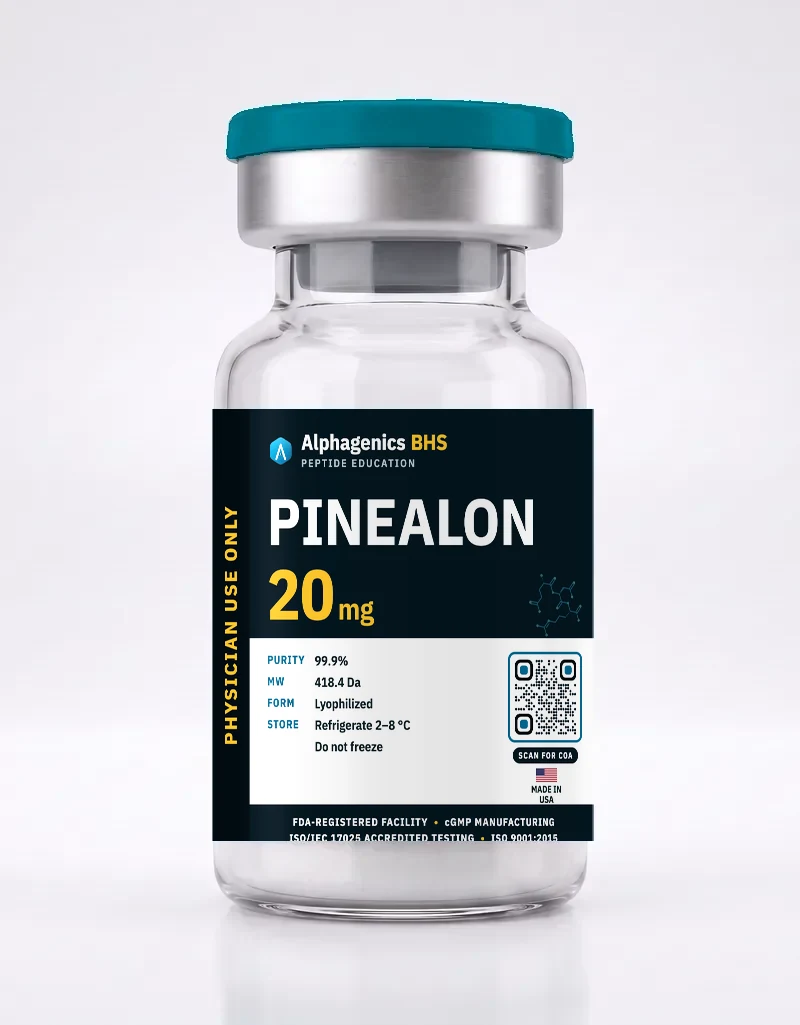
Pinealon
Glu-Asp-Arg · EDR · T-33
Synthetic tripeptide (short peptide bioregulator)
About Pinealon
Pinealon (Glu-Asp-Arg, EDR) is a synthetic tripeptide developed by Professor Vladimir Khavinson's group at the Saint Petersburg Institute of Bioregulation and Gerontology.
It has been studied in cultures of neurons and other cells under oxidative stress, in cell and mouse models of Alzheimer's disease, and in the offspring of rats exposed to prenatal hyperhomocysteinemia, in relation to antioxidant and neuroprotective effects. Its authors propose that it may interact directly with the genome. The evidence comes largely from a single research group and is mostly preclinical.
Structure and sequence
Sequence

Five findings from studies
Summary of results reported in the scientific literature. Each finding describes what was observed in the cited study, in its specific population and conditions; it does not constitute a therapeutic indication.
-
In vitro
In cerebellar granule cells, neutrophils and PC12 cells under oxidative stress, it has shown a dose-dependent reduction in reactive oxygen species and in necrotic cell death.
Khavinson V et al. Rejuvenation Res. 2011;14:535-541 · PMID 21978084 -
Preclinical
In the offspring of rats with prenatal hyperhomocysteinemia, giving it to the mothers has been associated with better spatial orientation and learning, and with cerebellar neurons more resistant to oxidative stress.
Arutjunyan A et al. Int J Clin Exp Med. 2012;5:179-185 · PMID 22567179 -
In vitro
In a primary culture of mouse hippocampal neurons under amyloid synaptotoxicity (a model of Alzheimer's disease), EDR has been associated with a 71% increase in the number of mature ("mushroom") dendritic spines, returning it to the normal level; the tripeptide KED increased them by 20%.
Kraskovskaya NA et al. Bull Exp Biol Med. 2017;163:550-553 · PMID 28853087 -
Preclinical
In 5xFAD mice, a model of Alzheimer's disease, the EDR and KED peptides have been associated with prevention of dendritic spine loss; using molecular modeling, the authors described possible EDR binding sites in the promoters of genes such as CASP3, GAP43, APOE and SOD2.
Khavinson V et al. Pharmaceuticals (Basel). 2021;14:515 · PMID 34071923 -
In vitro
In cortical neurons induced from fibroblasts of elderly donors, EDR, like KED and AEDG, has been associated with greater dendritic arborization, and EDR with reduced oxidative DNA damage; the tripeptides did not change mitochondrial or lysosomal activity or p16 protein levels.
Kraskovskaya N et al. Int J Mol Sci. 2024;25:11363 · PMID 39518916
Frequently asked questions
What is Pinealon?
Pinealon (Glu-Asp-Arg, EDR) is a synthetic tripeptide developed by Professor Vladimir Khavinson's group at the Saint Petersburg Institute of Bioregulation and Gerontology. It has been studied in cultures of neurons and other cells under oxidative stress, in cell and mouse models of Alzheimer's disease, and in the offspring of rats exposed to prenatal hyperhomocysteinemia, in relation to antioxidant and neuroprotective effects.
What target or receptor does Pinealon act on?
Not established; direct interaction with the genome and regulation of gene expression have been proposed (proposed)
What is the half-life of Pinealon?
Not established in humans
What have published studies observed about Pinealon?
In cerebellar granule cells, neutrophils and PC12 cells under oxidative stress, it has shown a dose-dependent reduction in reactive oxygen species and in necrotic cell death. (Khavinson V et al. Rejuvenation Res. 2011;14:535-541, PMID 21978084) In the offspring of rats with prenatal hyperhomocysteinemia, giving it to the mothers has been associated with better spatial orientation and learning, and with cerebellar neurons more resistant to oxidative stress. (Arutjunyan A et al. Int J Clin Exp Med. 2012;5:179-185, PMID 22567179)
How is Pinealon stored?
Refrigerate at 2–8 °C, do not freeze. Protect from light and moisture, unopened and once reconstituted.
What sizes is Pinealon available in?
10mg · 20mg


