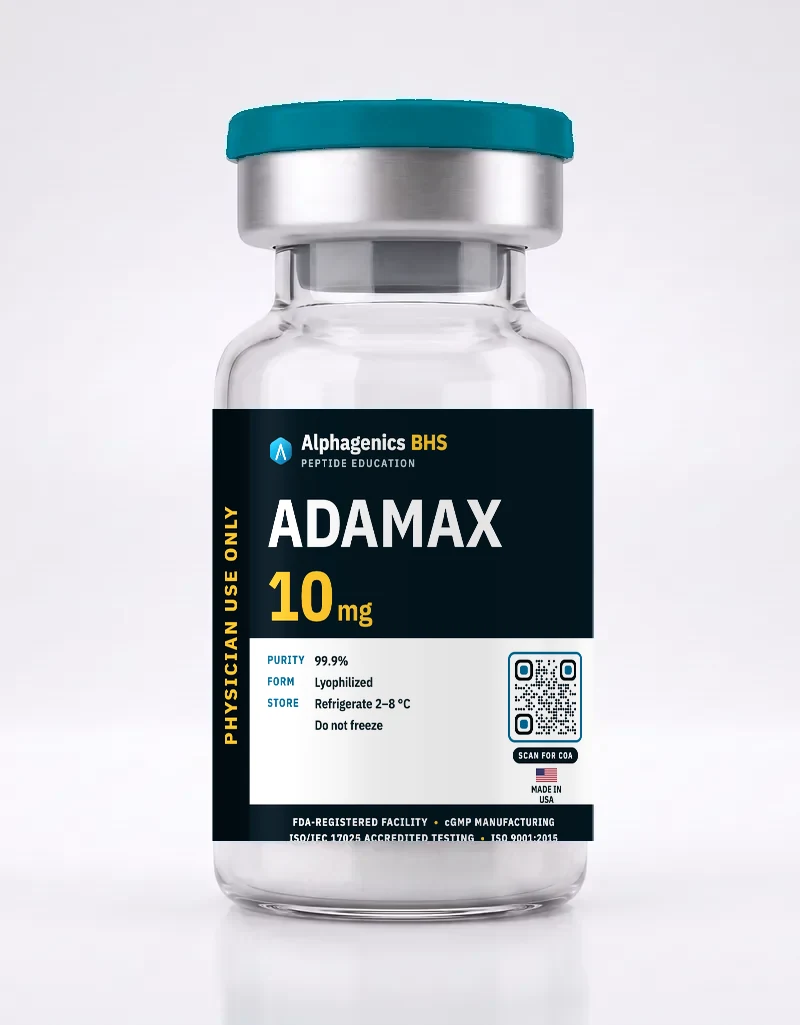
Adamax
Semax derivative
Peptide marketed as a Semax derivative (ACTH 4-10 analog)
About Adamax
Adamax is marketed as a derivative of Semax, the synthetic heptapeptide analog of the ACTH (4-10) fragment developed at the Institute of Molecular Genetics of the Russian Academy of Sciences.
It is usually described as Semax with a modification that incorporates an adamantane group. However, there are no scientific publications indexed in PubMed on Adamax, nor a verifiable description of its exact structure. For this reason, the findings below come from studies carried out with Semax, its parent molecule, and cannot be directly transferred to Adamax.

Five findings from studies
Summary of results reported in the scientific literature. Each finding describes what was observed in the cited study, in its specific population and conditions; it does not constitute a therapeutic indication.
-
Preclinical
Semax (parent molecule): in rats, intranasal application of Semax has been associated with a rapid increase in BDNF protein levels in the basal forebrain at 3 hours, but not in the cerebellum; specific binding sites for the peptide were identified in that region.
Dolotov OV et al. J Neurochem. 2006;97 Suppl 1:82-86 · PMID 16635254 -
Preclinical
Semax (parent molecule): in rats, a single application of Semax has shown a maximal 1.4-fold increase in BDNF protein levels and a 1.6-fold increase in phosphorylation of its TrkB receptor in the hippocampus, together with a greater number of conditioned avoidance reactions.
Dolotov OV et al. Brain Res. 2006;1117:54-60 · PMID 16996037 -
Clinical study
Semax (parent molecule): in a study of 110 patients after ischemic stroke, divided into early or late rehabilitation groups with and without Semax, its administration has been associated with higher plasma BDNF levels and better recovery on the Barthel index; according to the authors, it had less influence on the reduction of paresis. The abstract does not describe randomization or placebo.
Gusev EI et al. Zh Nevrol Psikhiatr Im S S Korsakova. 2018;118:61-68 · PMID 29798983 -
Preclinical
Semax (parent molecule): in a rat model of focal cerebral ischemia, a transcriptome analysis has shown that Semax mainly alters the expression of immune-system genes, as well as genes linked to the vascular system.
Medvedeva EV et al. BMC Genomics. 2014;15:228 · PMID 24661604 -
Preclinical
Semax (parent molecule): in male rats subjected to chronic unpredictable stress, Semax has been associated with reversal or attenuation of anhedonia, reduced body-weight gain, adrenal hypertrophy and the decrease in hippocampal BDNF; in the forced swim test, no effects of the peptides on immobility were detected.
Inozemtseva LS et al. Eur J Pharmacol. 2024;984:177068 · PMID 39442746
Frequently asked questions
What is Adamax?
Adamax is marketed as a derivative of Semax, the synthetic heptapeptide analog of the ACTH (4-10) fragment developed at the Institute of Molecular Genetics of the Russian Academy of Sciences. It is usually described as Semax with a modification that incorporates an adamantane group.
What target or receptor does Adamax act on?
Not characterized; the BDNF/TrkB system has been proposed for Semax
What is the half-life of Adamax?
Not established in humans
What have published studies observed about Adamax?
Semax (parent molecule): in rats, intranasal application of Semax has been associated with a rapid increase in BDNF protein levels in the basal forebrain at 3 hours, but not in the cerebellum; specific binding sites for the peptide were identified in that region. (Dolotov OV et al. J Neurochem. 2006;97 Suppl 1:82-86, PMID 16635254) Semax (parent molecule): in rats, a single application of Semax has shown a maximal 1.4-fold increase in BDNF protein levels and a 1.6-fold increase in phosphorylation of its TrkB receptor in the hippocampus, together with a greater number of conditioned avoidance reactions. (Dolotov OV et al. Brain Res. 2006;1117:54-60, PMID 16996037)
How is Adamax stored?
Refrigerate at 2–8 °C, do not freeze. Protect from light and moisture, unopened and once reconstituted.
What sizes is Adamax available in?
10mg


