ARA-290
Cibinetide · pHBSP · ARA 290
Non-erythropoietic peptide derived from helix B of erythropoietin, innate repair receptor agonist
About ARA-290
ARA-290 (cibinetide) is an 11-amino-acid peptide designed from the three-dimensional structure of erythropoietin (EPO), specifically the aqueous face of its helix B; for this reason it is also called pHBSP (pyroglutamate helix B surface peptide).
EPO acts through two distinct receptors: the EPO receptor homodimer, responsible for red blood cell production, and a heterocomplex of the EPO receptor with the β common receptor (CD131), called the innate repair receptor and linked to tissue protection. ARA-290 was designed to activate only the latter, without an erythropoietic effect. It has been studied in phase 2 trials in small fiber neuropathy associated with sarcoidosis and with type 2 diabetes, with mixed results depending on the endpoint. It has no regulatory approval.
Structure and sequence
Sequence

Five findings from studies
Summary of results reported in the scientific literature. Each finding describes what was observed in the cited study, in its specific population and conditions; it does not constitute a therapeutic indication.
-
Preclinical
In animal models, an 11-amino-acid peptide reproducing the aqueous face of erythropoietin helix B has shown a tissue-protective effect in cerebral ischemia and renal ischemia-reperfusion, and has been associated with faster wound healing and better cognitive function in rodents, with no erythropoietic effect in vitro or in vivo.
Brines M et al. Proc Natl Acad Sci U S A. 2008;105:10925-10930 · PMID 18676614 -
Clinical study
In a double-blind, placebo-controlled pilot trial in 22 patients with sarcoidosis and symptoms of small fiber neuropathy (4 weeks, intravenous), no safety concerns were raised and the ARA-290 group showed a significant improvement on the small fiber neuropathy screening list (SFNSL) versus placebo; pain (BPI) and fatigue (FAS) improved equally in both groups, and depressive symptoms did not change.
Heij L et al. Mol Med. 2012;18:1430-1436 · PMID 23168581 -
Clinical study
In a 28-day randomized phase 2b trial in 64 patients with sarcoidosis-associated small nerve fiber loss and neuropathic pain, cibinetide at 4 mg/day has been associated with a significant increase in corneal nerve fiber area (the primary endpoint) versus placebo; the 1 and 8 mg/day doses did not reach significance, and pain improved in all groups, including placebo.
Culver DA et al. Invest Ophthalmol Vis Sci. 2017;58:BIO52-BIO60 · PMID 28475703 -
Clinical study
In a placebo-controlled phase 2 study in people with type 2 diabetes and painful neuropathy (28 days subcutaneous, plus one month of follow-up), ARA-290 has been associated with improvements in hemoglobin A1c and lipid profile, and in neuropathic symptoms on the PainDetect questionnaire; no safety issues were identified.
Brines M et al. Mol Med. 2015;20:658-666 · PMID 25387363 -
Clinical study
In an uncontrolled phase 2 trial in 9 patients with diabetic macular edema (12 weeks subcutaneous), no mean improvement was seen in visual acuity, central retinal thickness, retinal sensitivity or tear production; the NEI VFQ-25 visual function questionnaire score did improve, and there were no serious adverse events or anti-peptide antibodies.
Lois N et al. J Clin Med. 2020;9:2225 · PMID 32674280
Frequently asked questions
What is ARA-290?
ARA-290 (cibinetide) is an 11-amino-acid peptide designed from the three-dimensional structure of erythropoietin (EPO), specifically the aqueous face of its helix B; for this reason it is also called pHBSP (pyroglutamate helix B surface peptide). EPO acts through two distinct receptors: the EPO receptor homodimer, responsible for red blood cell production, and a heterocomplex of the EPO receptor with the β common receptor (CD131), called the innate repair receptor and linked to tissue protection.
What target or receptor does ARA-290 act on?
Innate repair receptor (EPO receptor / CD131 β common receptor heterocomplex)
What is the half-life of ARA-290?
Short plasma half-life, about 2 minutes (review by Collino et al., 2015)
What have published studies observed about ARA-290?
In animal models, an 11-amino-acid peptide reproducing the aqueous face of erythropoietin helix B has shown a tissue-protective effect in cerebral ischemia and renal ischemia-reperfusion, and has been associated with faster wound healing and better cognitive function in rodents, with no erythropoietic effect in vitro or in vivo. (Brines M et al. Proc Natl Acad Sci U S A. 2008;105:10925-10930, PMID 18676614) In a double-blind, placebo-controlled pilot trial in 22 patients with sarcoidosis and symptoms of small fiber neuropathy (4 weeks, intravenous), no safety concerns were raised and the ARA-290 group showed a significant improvement on the small fiber neuropathy screening list (SFNSL) versus placebo; pain (BPI) and fatigue (FAS) improved equally in both groups, and depressive symptoms did not change. (Heij L et al. Mol Med. 2012;18:1430-1436, PMID 23168581)
How is ARA-290 stored?
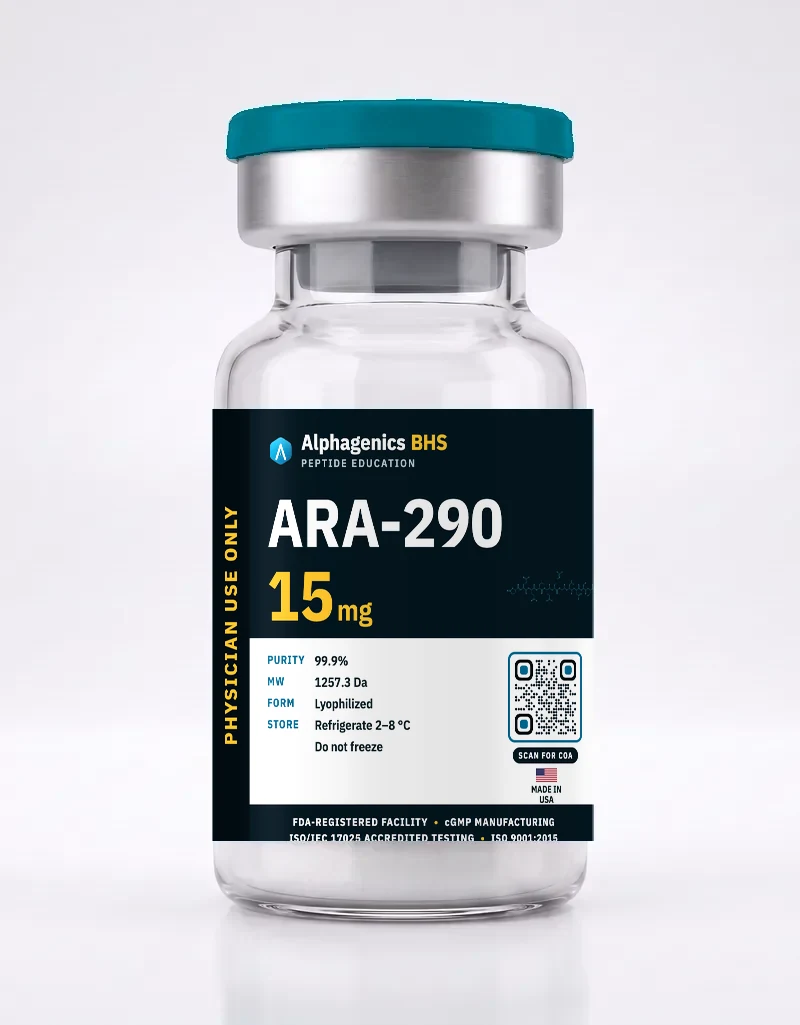
Refrigerate at 2–8 °C, do not freeze. Protect from light and moisture, unopened and once reconstituted.
What sizes is ARA-290 available in?
10mg · 15mg